Always ask permission before you photograph someone.
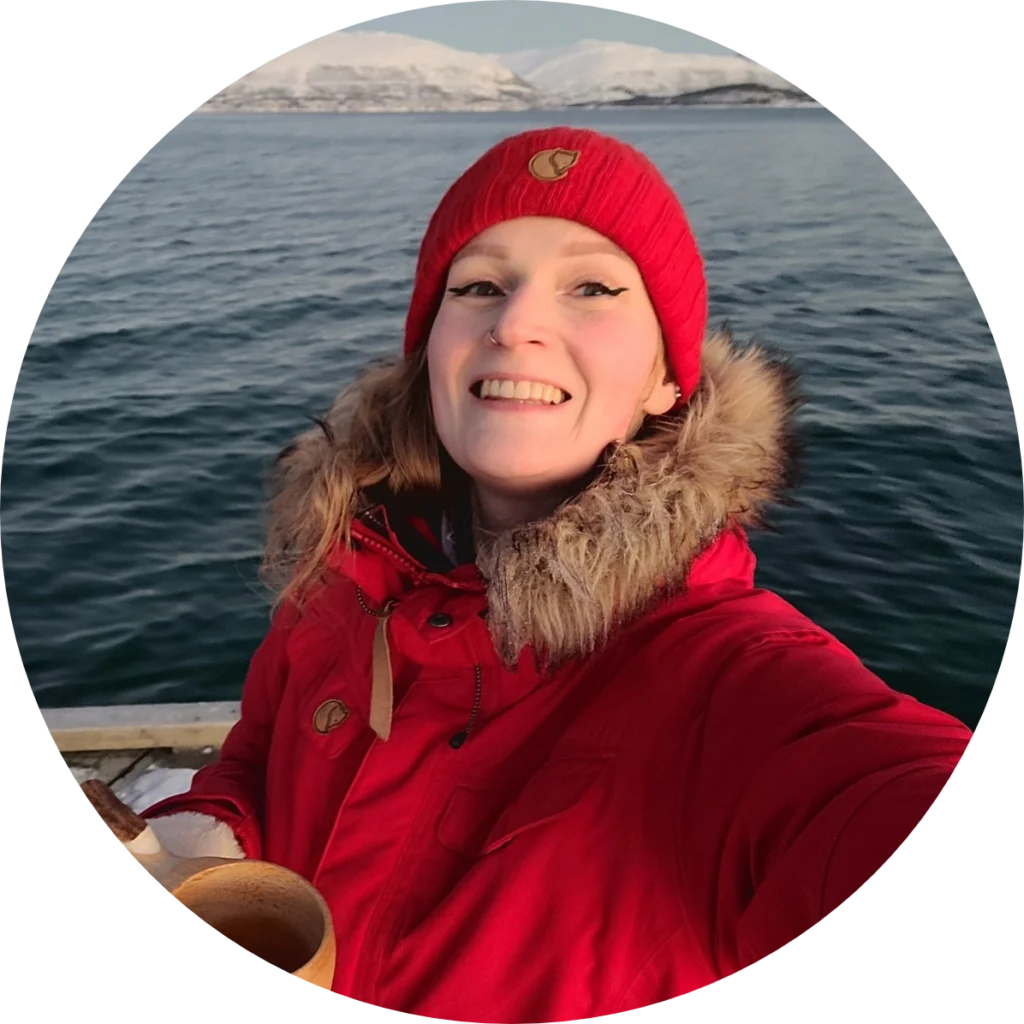
“To me, Lapland is a fairytale world for grown ups. Everyone should experience this once in their life.”
Michelle ∙ Lost in Norvana
Everything you need to know about Lapland
What you need to know about Lapland
Lapland isn’t a country but a region that stretches across the north of Norway, Sweden, Finland and Russia’s Kola Peninsula. Its original inhabitants, the Sámi, call their land Sápmi. This page is about Finnish, Swedish and Norwegian Lapland: the area above and around the Arctic Circle, where reindeer cross the road more often than cars do. In Norway that mainly means Finnmark and Troms, with Tromsø, Alta and the North Cape. You can read more about the rest of the country on my page Everything you need to know about Norway.
At around 100,000 km², Finnish Lapland alone is almost 2.5 times the size of the Netherlands, yet fewer than 180,000 people live there. Swedish Lapland is roughly as big and just as empty, and Finnmark, the northernmost part of Norway, is bigger than the whole of the Netherlands at around 48,000 km², with only some 75,000 inhabitants. Sometimes you’ll drive for an hour here without passing a single house, though you will pass a herd of reindeer. There are almost as many of them roaming Finland as there are people living in Lapland. Spoiler: every single one of them belongs to someone.
Finland and Sweden are members of the EU and Norway isn’t, but all three are part of the Schengen Area. So you can simply travel with your ID card. The big difference is in your wallet: in Finland you pay in euros, in Sweden in Swedish kronor and in Norway in Norwegian kroner. Beyond that, Lapland mostly has a great deal of what we miss in the Netherlands: space, silence, snow and a starry sky that leaves you speechless.
100,000 km²
Finnish Lapland: almost 2.5 times the Netherlands
< 180,000
inhabitants in the whole of Finnish Lapland
4 countries
Sápmi lies in Norway, Sweden, Finland and Russia
Climate and seasons in Lapland
Lapland has a subarctic climate: long, cold winters and short, surprisingly warm summers. In winter the average is between -10 and -20 °C, but -30 °C is no exception. Finland’s cold record of -51.5 °C was even measured in Kittilä, and Norway’s of -51.4 °C in Karasjok. Thanks to the Gulf Stream, the Norwegian coast is a lot milder, but inland, on the Finnmarksvidda plateau, it gets just as cold. In summer the mercury can easily climb to 25 °C. In between lies everything you can imagine, sometimes on the same day.
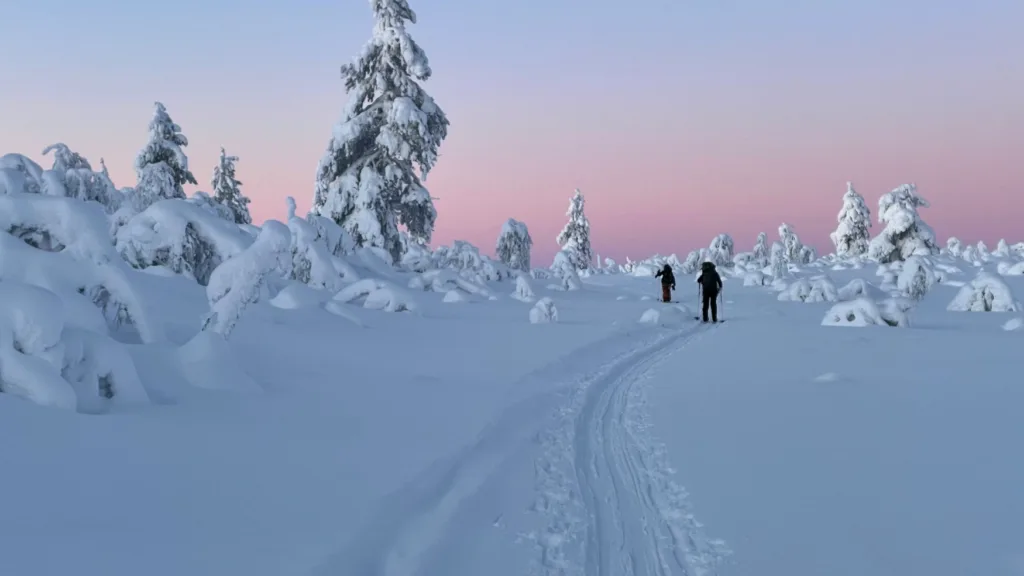
What makes Lapland truly special is the light. Above the Arctic Circle the sun doesn’t rise at all for a while in winter: the polar night, kaamos in Finnish. In the far north it lasts about seven weeks. It isn’t pitch dark, though: during the day the sky turns pink and deep blue for a few hours. In summer it’s the other way round and the sun doesn’t set for weeks. The Sámi don’t have four seasons but eight, and honestly, you only get that once you’ve been there.
Polar night & Christmas
Blue light, Christmas atmosphere, northern lights, the real Arctic winter
Nov – Jan
Spring winter
Long days, bright sun on deep snow, ideal for cross-country skiing and huskies
Feb – Apr
Midnight sun
24 hours of light, hiking until midnight (and mosquitoes)
Jun – Jul
Ruska
Autumn colours on the fells, the first northern lights, peace and quiet
Sep
If you can, avoid May and late October to mid-November. Everything is thawing or freezing, there’s too little snow to ski, and many accommodations and tours are closed.

Sámi culture
The Sámi are the only recognised indigenous people in the EU. They have lived in the north of Scandinavia and Russia for thousands of years. There are an estimated 80,000 to 100,000 Sámi, most of whom live in Norway. Norway, Sweden and Finland each have their own Sámi parliament; the Finnish one sits in the beautiful wooden Sajos building in Inari, the Norwegian one in Karasjok. Nine Sámi languages are still spoken, and some of them differ from each other more than Dutch and German do.
Reindeer herding is still the heart of Sámi culture. In Sweden and Norway, herding reindeer is largely reserved for the Sámi; in Finland other Finns are allowed to do it too. In Lapland you’ll also hear the joik, an age-old way of singing in which you don’t sing about something, but evoke someone or something. And then there’s the gákti, the colourful traditional dress that tells you which region someone comes from.
Want to know more? Then head to the Siida museum in Inari, the Ájtte museum in Jokkmokk or the Sámi museum in Karasjok. You’ll learn more about Lapland there in an afternoon than in a week of skiing.
How to travel respectfully through Sápmi
And then there are the Finns, the Swedes and the Norwegians themselves. Stand at a bus stop in Finland and you’ll see people waiting neatly three metres apart. That isn’t rude, it’s actually polite: you don’t bother other people. Small talk isn’t necessary and silences aren’t awkward. Swedes and Norwegians are a bit chattier, but love their space just as much. In Sweden everything revolves around lagom: not too much, not too little. All three have one thing in common: as soon as you’re sitting in a sauna or around a campfire, they suddenly open up.
Public holidays
Christmas is a big deal in Lapland, of course. According to the Finns, Father Christmas simply lives in Rovaniemi, and presents arrive here on 24 December. In Sweden the whole country watches Donald Duck at three o’clock that afternoon: a tradition since 1959, honestly. On 6 December Finland celebrates Independence Day and you’ll see two candles in windows everywhere. In Norway 17 May, Constitution Day, is the biggest celebration: in Tromsø and Alta, too, parades with flags fill the streets. On top of that, there are two days you really need to know about. Bear in mind that shops may be closed and public transport may run to a different timetable.
6 February
Sámi National Day
On this day the Sámi raise their flag in all four countries. You’ll see gákti everywhere, and there’s joiking and celebrating. Around the same time Jokkmokk holds its famous Winter Market, which has taken place every year in the first week of February since 1605. Reindeer races on the ice included.
Late June
Midsummer
In Finland it’s called Juhannus, in Sweden Midsommar: the weekend between 19 and 26 June, when the sun doesn’t set. In Norway they celebrate Sankthans on the evening of 23 June. The cities empty out and everyone heads to their cabin by the lake or the fjord. Finns and Norwegians light huge bonfires, Swedes dance around the maypole with flower crowns in their hair. Many shops are closed, but there’s atmosphere in abundance.
Lapland cuisine
Lapland cuisine is honest and pure, and revolves around what the land provides: reindeer, fish from the cold rivers and lakes, and berries. Lots and lots of berries. The best-known dish is poronkäristys: thinly sliced, sautéed reindeer with mashed potato and a generous spoonful of lingonberries. In Swedish and Norwegian Lapland you’ll eat suovas, reindeer meat smoked to a Sámi recipe, often in a wrap of flat gáhkku bread. And don’t forget the creamy salmon soup lohikeitto, perfect after a day in the snow.
Lapland’s gold is the cloudberry (lakka in Finnish, hjortron in Swedish and molte in Norwegian). This orange berry only grows in bogs in the far north and is so prized that there are places where you can’t just pick it. You eat it warm over leipäjuusto, a baked cheese that squeaks between your teeth. Sounds odd, but you’ll miss it.
And then there’s the coffee. Finns drink more coffee per person than anyone else in the world. In Lapland they sometimes drop cubes of kaffeost (coffee cheese) into it, which you fish out with a spoon once you’ve finished your drink. My advice? Just try it.
Money and paying in Lapland
In Lapland you’ll be dealing with three currencies. Luckily, paying is super easy in all three countries: you can pay contactless with your debit or credit card almost everywhere, right down to the tiniest coffee shop.
Finland
Euro
You simply pay in euros. Card payments and contactless work everywhere. Cash is handy for a market stall or a reindeer herder by the roadside, but you’ll hardly ever need it.
Sweden
Swedish krona (SEK)
One euro gets you about 11 kronor. Sweden is one of the most cashless countries in the world: in many places you can’t even pay in cash. So paying by card works perfectly. There’s really no need to exchange money.
Norway
Norwegian krone (NOK)
One euro gets you about 11.5 Norwegian kroner. In Norway, too, you can pay almost everywhere with your debit or credit card, even at a stall by the roadside. You won’t really need cash.
Whatever you do, bring a credit card. You’ll need it for the deposit on your hire car and at unstaffed petrol stations, of which Lapland has quite a few.
Groceries
Grocery shopping in Lapland is a little more expensive than in the Netherlands. In bigger towns like Rovaniemi, Kiruna and Tromsø it’s not too bad, but in remote villages and ski resorts you’ll quickly pay a lot more. So stock up whenever you pass a big supermarket.
In Finland Lidl is the cheapest. Then there’s the S Group (S-Market and the large Prisma) and the K Group (from K-Market to K-Citymarket). In Sweden Lidl and Willys are the cheapest, with ICA and Coop in the mid-range. In the smallest villages the ICA is often the only shop, doubling as post office and meeting place. In Norway Rema 1000, Kiwi and Coop Extra are the cheapest, but expect to pay quite a bit more there than in Finland and Sweden.
Fancy a drink on holiday? Then it’s worth knowing how things work in all three countries, because you can’t just buy spirits in the supermarket.
Buying and bringing alcohol
Buying in Finland
In the supermarket you can buy beer, cider and wine up to 8%. Anything stronger you buy at the state-run shop Alko. You have to be 18 (20 for drinks over 22%).
Buying in Sweden
In the supermarket you can only buy drinks up to 3.5%. Everything else you buy at Systembolaget, from the age of 20.
Buying in Norway
In the supermarket you can only buy beer and cider up to 4.7%, and only until 20:00 (18:00 on Saturdays). Wine and spirits you buy at Vinmonopolet, from the age of 18 (20 for drinks over 22%).
Good to know
Alko, Systembolaget and Vinmonopolet are closed on Sundays, and often close early on Saturdays.
Bringing it from the Netherlands
Travelling to Finland and Sweden means travelling within the EU, so you can bring alcohol for your own use. The EU guideline per person is:
10 litres of spirits
20 litres of intermediate products (such as port)
90 litres of wine
110 litres of beer
For Sweden you must be at least 20 to bring in alcohol, for Finland 18 (20 for drinks over 22%). Norway isn’t in the EU, so you can bring in much less there. You’ll find the amounts on my Norway page. Before you leave, check the current rules with Finnish (tulli.fi), Swedish (tullverket.se) or Norwegian customs (toll.no).
Rovaniemi and other places in Lapland
Rovaniemi is the capital of Finnish Lapland and, with around 65,000 inhabitants, also its largest town. At the end of the Second World War it was almost completely burnt down by retreating German troops. Architect Alvar Aalto then designed a new street plan in the shape of… a reindeer’s antlers. A few kilometres outside town lies the Arctic Circle, and that’s where, according to the Finns, Father Christmas lives, in Santa Claus Village. Want to really understand Lapland? Then visit the Arktikum museum.
Other places you should know are Inari, the Sámi heart of Finland, the ski villages of Levi, Ylläs and Saariselkä, and in Sweden Kiruna and Abisko. Kiruna is a remarkable story: because the iron ore mine beneath the town keeps expanding, the entire town centre is being moved a few kilometres, wooden church and all. Nearby, in Jukkasjärvi, the famous Icehotel has been rebuilt every winter since 1989 from river ice.
In Norwegian Lapland they are Tromsø, the largest town in northern Norway with around 78,000 inhabitants, Alta with its rock carvings that are thousands of years old (a UNESCO World Heritage Site), and Karasjok and Kautokeino, Norway’s main Sámi towns. And then, of course, there’s the famous North Cape.
Finnish Lapland
Rovaniemi
the capital, on the Arctic Circle
Inari
the Sámi heart of Finland
Levi, Ylläs and Saariselkä
the ski villages
Swedish Lapland
Kiruna
the mining town on the move
Abisko
fells and the ‘blue hole’
Jukkasjärvi
a new Icehotel every winter
Norwegian Lapland
Tromsø
the largest town in the north
Alta
rock carvings and northern lights
Karasjok and Kautokeino
the Sámi heart of Norway
Mosquitoes in Lapland
Everything you’ve heard about mosquitoes in Lapland is true. The Finns even have their own word for it: räkkä, the period when mosquitoes, flies and horseflies rule. It runs from about mid-June to the end of July, exactly when the midnight sun is at its most beautiful. Of course. In August the midges take over, which are even smaller and at least as annoying.
Luckily, you can protect yourself perfectly well. Wear long sleeves and long trousers, and bring a mosquito head net when you go hiking. You’ll look ridiculous, but nobody here will see you anyway. Buy your insect repellent locally: it really works much better than what you can buy in the Netherlands. Djungelolja comes from Sweden, of all places, and is my personal favourite. It smells strong and doesn’t soak in, but the mosquitoes simply fly away from you.
Clothing tips
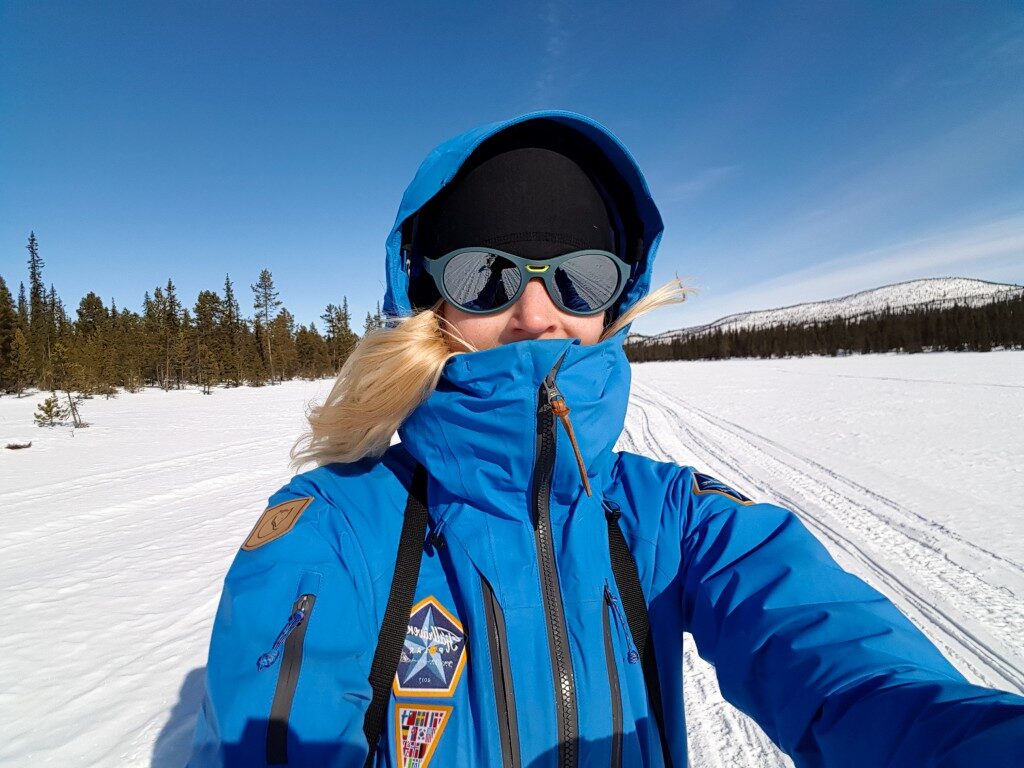
The secret to a great winter in Lapland? Layers. Start with a thermal base layer of wool or merino right against your skin, a warm fleece or down jacket over that, and as your outer layer a jacket and trousers that are windproof and waterproof. Avoid cotton: it gets damp from your sweat and then you actually get cold. At -25 °C you especially want to protect your hands, feet and face well: wear mittens (they’re warmer than gloves) with thin gloves underneath, thick woollen socks and a neck warmer or buff. Buy your winter boots a size bigger, so there’s room for an extra pair of socks.
Layer 1
Base layer
wool or merino, right against your skin
Layer 2
Warm layer
fleece or down jacket
Layer 3
Outer layer
jacket and trousers, windproof and waterproof
Good to know: on many husky, snowmobile and reindeer trips you’ll be lent a thermal overall and boots. In summer, the tips from my Norway page apply: make sure you stay dry and can always put something on or take something off.
Getting around Lapland
By plane
Lapland is closer than you think. In winter KLM flies direct from Schiphol to Rovaniemi and Kittilä (the airport for Levi and Ylläs). You’ll be there in about three hours. In the 2025–2026 winter season KLM flew to Rovaniemi four times a week and to Kittilä every Sunday. Outside the winter season, the easiest way to fly is via Helsinki to Rovaniemi, Kittilä, Ivalo or Kuusamo, or via Stockholm to Kiruna and Luleå. For Norwegian Lapland you fly via Oslo to Tromsø, Alta or Kirkenes.
By car
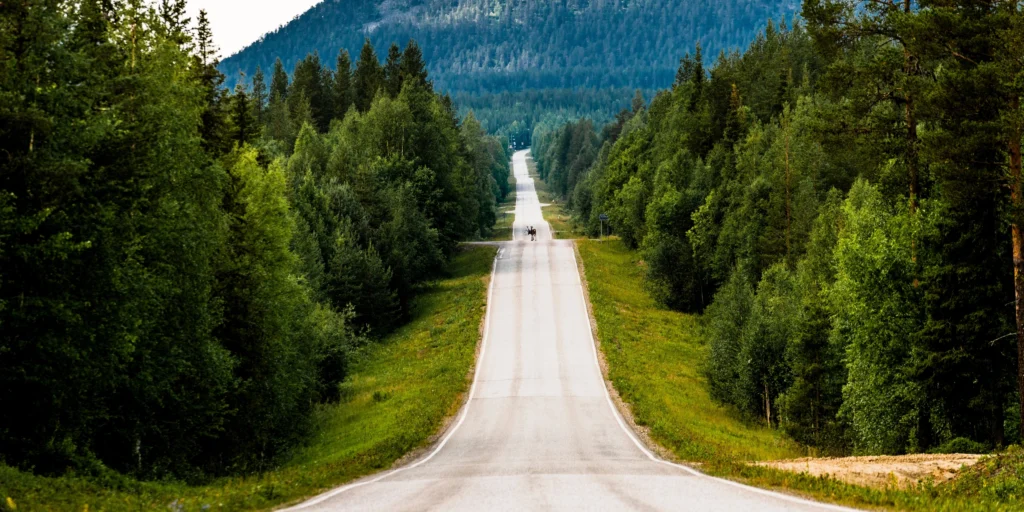
If you really want to explore Lapland, hire a car. The distances are huge: from Rovaniemi to Inari is already well over 300 kilometres, and along the way you’ll mainly see forest, lakes and reindeer. Petrol stations are few and far between, so ideally fill up as soon as your tank is half empty. There are hardly any motorways; you’ll usually drive at 80 to 100 km/h on quiet, straight roads. That sounds boring, but it never is. There’s always a chance of a reindeer standing in the middle of the road and it rarely is in a hurry.
Summer
Driving in summer
Long, light days and empty roads: perfect for a road trip. Do watch out for reindeer, though, which love standing on the warm tarmac in summer to escape the mosquitoes. And because it never gets dark, it’s easy to lose track of time. So plan your breaks.
Winter
Driving in winter
Perfectly doable, but different. Hire cars come with winter tyres as standard, often studded. The roads are well cleared, but almost always white. Drive calmly, keep your distance and expect little daylight. Spot a post with a socket in a car park? That’s where your car plugs into the engine heater overnight, otherwise it won’t start at -30 °C.
Traffic rules
The traffic rules in Finland, Sweden and Norway are very similar to those in the Netherlands. A few things to watch out for:
The most beautiful routes
There are no official tourist routes in Finnish and Swedish Lapland, but there are in Norwegian Lapland: Varanger and Havøysund are part of Norway’s Nasjonale turistveger (National Tourist Routes). And everywhere you’ll find roads that are a destination in themselves. My favourites:
E8 Tornio – Kilpisjärvi
along the Swedish border to Finland’s ‘arm’
open all year round
Rovaniemi – Inari – Utsjoki
straight through the Sámi heart of Lapland
open all year round
Utsjoki – Nuorgam
along the Teno River to the northernmost village in the EU
open all year round
Kiruna – Abisko – Narvik (E10)
from mining town to the Norwegian fjords
all year round, sometimes closed in storms
Tornedal: Haparanda – Karesuando
along the border river with Finland
open all year round
Vildmarksvägen
Sweden’s highest paved road
approx. June to October
Varanger
along the Barents Sea to the fishing village of Hamningberg
late May to mid-November
Havøysund
over bare rocks along the Arctic Ocean
open all year round
By train
Lapland by train is an adventure in itself. In Finland the night train runs from Helsinki to Rovaniemi in about twelve hours, and in season it continues to Kolari. You can even take your car on the train. In Sweden the night train runs from Stockholm to the north; for Kiruna and Abisko you change at Boden in 2026. My personal favourite is the Ore Line from Kiruna via Abisko to Narvik in Norway. You go straight from the Swedish fells into the Norwegian fjords. In summer you can also take the Inlandsbanan for a leisurely trundle through the interior to the north.
By bus
No car? You’ll get further by bus than you might think. In Finland long-distance buses connect Rovaniemi with Inari, Ivalo and Kilpisjärvi, among others, and in winter ski buses run from the airports to the ski villages. In Swedish Lapland the regional operator is Länstrafiken Norrbotten. In Norwegian Lapland regional buses link the bigger towns, such as Tromsø, Alta and Karasjok, and along the coast the Hurtigruten ship simply doubles as public transport. Do always check the timetable: sometimes there’s only one bus a day.
Dreaming of Lapland by now?
Then leave the research to me. Choose one of my Lapland trips, have your trip completely tailor-made, or set off on your own with a personal travel plan.
Hiking in Lapland
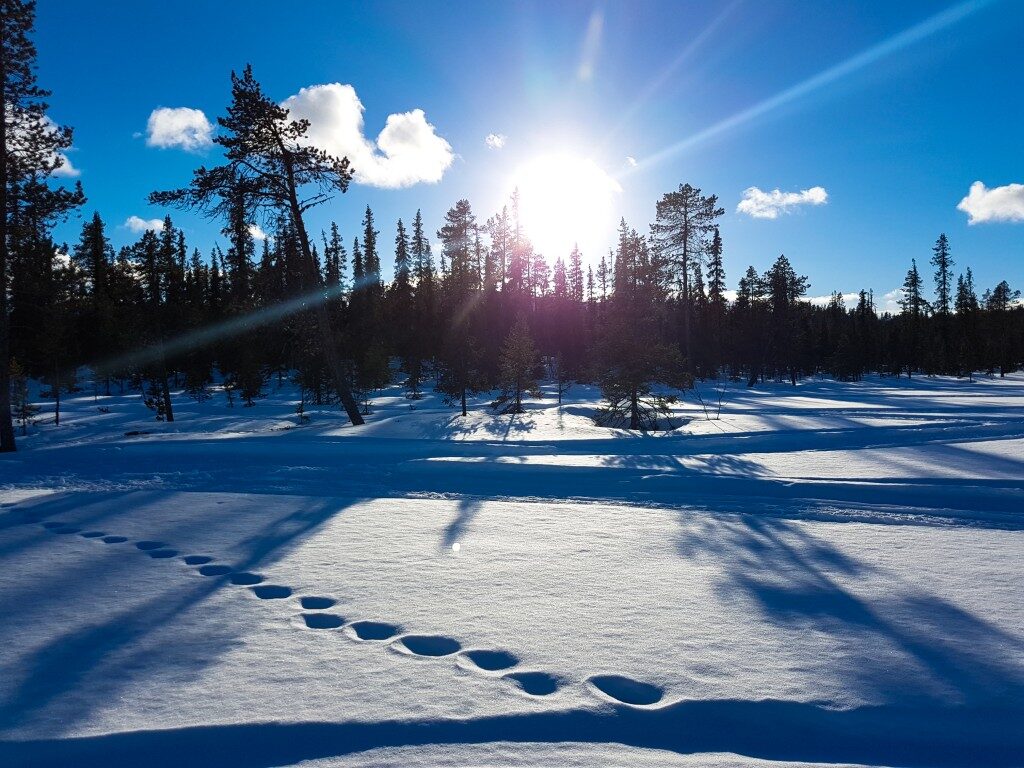
In Lapland you can walk for hours without meeting a soul. No jagged peaks like in southern Norway, but endless, rolling fells (tunturi in Finnish) and plateaus like the Finnmarksvidda: bare, rounded hills above the treeline with views all the way to the horizon. Whether you want to do a day hike or spend a week trekking from hut to hut with your rucksack, this is the place to do it. And in winter you simply swap your hiking boots for snowshoes or cross-country skis.
National parks
Finnish, Swedish and Norwegian Lapland are full of protected nature. In Sweden, Sarek, Padjelanta, Stora Sjöfallet and Muddus, together with two nature reserves, make up the Laponia area, a UNESCO World Heritage Site since 1996 for its nature and its Sámi culture. Sarek is sometimes called Europe’s last wilderness: there are no marked trails and no huts. So it’s for experienced hikers only.
The best-known national parks:
The most beautiful hikes
Hiking is very personal. One person loves a gentle circular walk, another wants to see nobody for a whole week. Below are my favourite hikes in Lapland.
Hetta – Pallas
one of the oldest marked trails in Finland (55 km)
Kungsleden
Abisko – Nikkaluokta, Sweden’s most famous multi-day hike
Karhunkierros
the 82 km ‘Bear’s Ring’ through Oulanka
Saana
the sacred mountain of Kilpisjärvi
Treriksröset
hike to the point where three countries meet
Isokuru
Finland’s deepest gorge, in Pyhä-Luosto
Korouoma
frozen waterfalls in winter
Nordkalottleden
800 km through Norway, Sweden and Finland
My general tips for hiking in Lapland
Routes are well marked in all three countries. In Finland you usually follow orange paint stripes on trees and wooden signposts. In the Swedish fells you follow red dots on stones and cairns in summer, and in winter poles with red crosses on them. In Norway you follow the red Ts of the Norwegian Trekking Association, DNT.
Right to roam
In all three countries the right to roam applies: jokamiehenoikeus in Finnish, allemansrätten in Swedish and allemannsretten in Norwegian. Everyone is free to go out into nature to hike, ski, cycle and camp, as long as you respect it. The golden rule: leave everything as you found it, and preferably even better.
Staying safe
My 8 rules for the Lapland wilderness
Lapland is beautiful, but nature is in charge here. Follow these rules and you’ll always get back safely.
In an emergency, call 112 in Finland and Sweden. In Norway 112 is the police, and you call 113 for an ambulance. Before you leave, install the 112 Suomi app (Finland) or Hjelp 113 (Norway): it lets the emergency services see where you are. Do make sure you set the app up properly beforehand.
Winter in Lapland
For most people Lapland is simply synonymous with winter, and I completely get it. Few things are as magical as gliding through a snowy forest behind a team of huskies while the sky turns pink.
Northern lights
From roughly late August to early April you can see the northern lights in Lapland. In the north of Finnish Lapland that happens on about 200 nights a year. The lights appear when charged particles from the sun collide with gases in our atmosphere (read more here!). You can follow how strong the activity is with a northern lights app, but the most important thing is a clear sky and as little artificial light as possible. Abisko is known for its ‘blue hole’: thanks to its microclimate, the sky there is clear more often than in the rest of the region. In Norwegian Lapland, Tromsø and Alta are the best-known bases.
Polar night
During the polar night the sun doesn’t rise above the Arctic Circle, but you’re not sitting in the dark. Around midday the sky turns soft pink, purple and deep blue for a few hours: the most beautiful light I know. For photographers it’s a dream.

Huskies and reindeer
A husky sled or reindeer sleigh ride is on almost everyone’s list. Do choose consciously, though: ask how the dogs live, how much they run each day and whether they get a good retirement after their working life. Reindeer farms are often run by Sámi families. There you’ll also really learn something about their way of life.
Sauna
And then there’s the sauna: in Finland it’s not an outing but a way of life. There are an estimated three million saunas for 5.6 million inhabitants, and since 2020 Finnish sauna culture has been on the UNESCO list of intangible cultural heritage. Dare to try? Then after a good sweat, run through the snow for a moment or take a dip in a hole in the ice, an avanto. You’ll never have felt so alive.
Frequently asked questions about Lapland
Do you need a passport for Lapland?
No. Finland, Sweden and Norway are all part of the Schengen Area, so a valid ID card is enough.
When is the best time to go to Lapland?
For snow and northern lights, the best time to go is between December and March. February and March have the advantage of more daylight. If you want to hike, go in July or September: in September you also get the autumn colours and fewer mosquitoes.
How many hours of daylight does Lapland get in winter?
That depends on where you are. In Rovaniemi you still get a few hours of daylight around Christmas. In the far north the sun doesn’t rise at all for about seven weeks, although the twilight gives a few hours of light during the day.
How cold does it get in Lapland?
In winter it’s usually between -10 and -20 °C, but -30 °C is not unusual. Thanks to the Gulf Stream, the Norwegian coast is milder. Because the cold is dry, it feels less cold than you’d expect, as long as you’re dressed properly.
How long is the flight to Lapland?
With a direct flight from Schiphol you’ll be in Rovaniemi or Kittilä in about three hours. With a change in Helsinki, Stockholm or Oslo (for Tromsø and Alta), the journey takes five to seven hours.
Can you pay in euros in Lapland?
In Finnish Lapland, yes. In Swedish Lapland you pay in Swedish kronor, in Norwegian Lapland in Norwegian kroner. In all three countries you can pay almost everywhere with your debit or credit card.
Contents