

The northern lights have fascinated us ever since humankind has walked this planet. But what do we actually know about this special phenomenon? And what do we just think we know about it? And how do you capture it on camera? In this article you’ll find everything you need to know about the northern lights!
- Northern lights, how do they actually form?
- Where can you see the northern lights?
- When can you see the northern lights?
- Folklore about the northern lights
- Photographing the northern lights
- Northern lights tour or chasing them yourself?
- Did you know?
- Handy apps and websites

Northern lights, how do they actually form?
Everyone knows what the northern lights are. But how do those dancing green ribbons in the sky actually form? The northern lights are caused by solar wind. Every now and then, eruptions on the sun fire large amounts of charged particles at the earth.
Luckily our earth has an iron core, which creates a kind of big protective bubble around our planet, also known as the earth’s magnetic field. It’s the same phenomenon that makes a compass always point to magnetic north. This bubble makes sure all those charged particles are neatly deflected along the lines of the earth’s magnetic field and guided around the Earth, instead of crashing into it. If we didn’t have this bubble, we’d regularly come into contact with deadly cosmic radiation here on earth..
So it’s a pretty handy thing to have. Sometimes the bands of our protective bubble snap, and a small amount of charged particles shoots (back) along those paths, toward the North Pole or the South Pole. Right where space ends and our atmosphere begins, something really special happens: the moment the charged particles bounce off our atmosphere, we see the phenomenon that above the North Pole we call the Aurora Borealis and above the South Pole the Aurora Australis.
Aurora Auswhatnow?
Aurora Australis! That’s the lesser-known twin sister of the northern lights: the southern lights. Unlike the northern lights, the southern lights are best seen between March and September. The best place to witness the phenomenon is Antarctica, but a slightly more accessible option is New Zealand, for example. In general there’s much less information available about the southern lights than about the northern lights, but basically the same conditions apply. The sky has to be clear, you have to be in a place with as little light pollution as possible, and enough particles have to bounce off the atmosphere to be visible. So for a southern lights forecast you can simply use the same apps and websites as for the northern lights!
But those particles aren’t green, are they?
Correct. The color of the northern lights depends entirely on the altitude at which the solar wind hits our atmosphere. The molecules and atoms the particles come into contact with determine the color of the light. Usually those are oxygen atoms, which produce a red or green color, depending on the energy level. The reason the northern lights are often green is that the human eye is more sensitive to green light than to red light. If the solar winds come into contact with nitrogen molecules, that can even cause purple or red northern lights. In a very rare case, the northern lights are even blue!
Where can you see the northern lights?
The best and most visited places to see the northern lights are Iceland, Svalbard, Canada, Alaska, Russia, Norway, Sweden and Finland. In very rare cases you can also see the northern lights in Scotland and on the Wadden Islands here in the Netherlands, where I live.
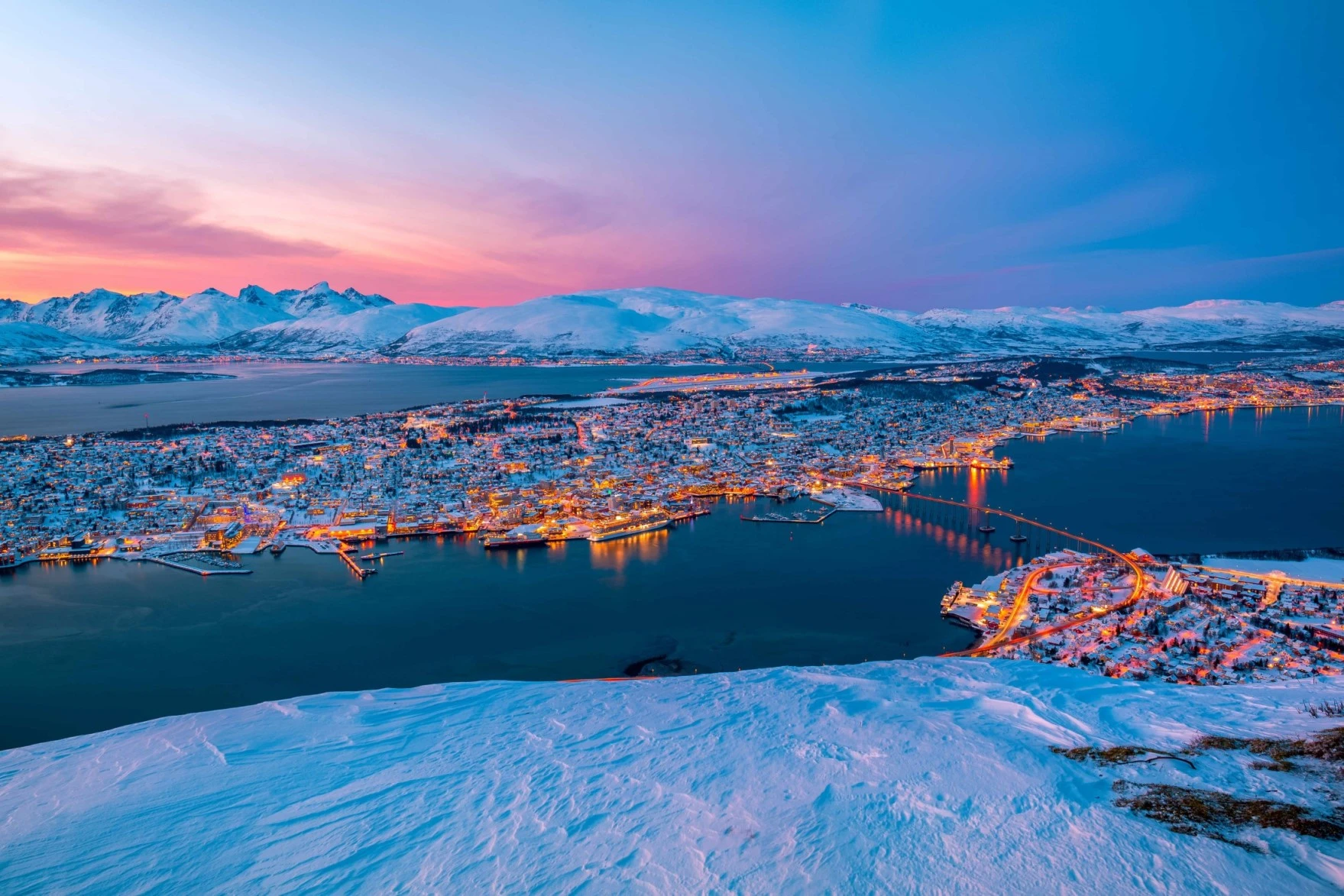
In Norway specifically, the Lofoten Islands and Tromsø are a great base for trying your luck at admiring the northern lights. In the north of Norway, at the height of winter, it barely gets light during the day (or, actually, not at all), so you have an extra good chance of meeting Aurora. Svalbard is also a perfect place for a northern lights show, but it’s more for the slightly more adventurous traveler. The winter there is just a little harsher, and the island is generally a bit less accessible than the more touristy places in Norway.

The KP index
Generally speaking, it’s the usual suspects when it comes to places where you can see the northern lights, but in the end it all depends on just one thing: the KP index. The strength of the solar wind is expressed with a KP index. On a scale of 0 to 9, this index determines how far across the world the northern lights are visible. If the KP index is 1, the northern lights are only visible at the very top of Norway. If the KP index is 9, you can even see the northern lights in the north of the Netherlands. The chance of northern lights in the Netherlands is very small, though: on average they’re seen seven times a year.

When can you see the northern lights?
In theory, March is the best month of the year to see the northern lights in Norway. In practice, it’s a little different. Chasing the northern lights is also partly a matter of luck. The weather conditions have to be right (clear skies), the KP index has to be right (solar flares), there can’t be any air pollution, and on top of that it has to be dark enough. It could easily snow/rain/be cloudy the whole month of March, so you don’t see a thing! So you can never be sure, but if you want to go to Norway for the northern lights, your best bet is between September and April. In the months before and after, there are solar flares, but it’s simply light for too long to see anything.

Folklore about the northern lights
A special natural phenomenon like this obviously leads to a lot of speculation. Especially back when we didn’t do, or rather couldn’t do, any scientific research into the northern lights. Since the beginning of time, the northern lights have inspired lots of fun myths, legends and rumors, which is why the phenomenon is both worshipped and feared.
In most places where the northern lights are common, people long believed that loved ones who had passed away were trying to contact the people they left behind through the lights. The Inuit even believed the sky turned green because spirits were playing soccer with a walrus head or skull. The Inuit of Nunivak believed the opposite: that walrus spirits were playing soccer with a human skull. For a long time the Swedes thought there was a kind of volcano at the North Pole that brought light and warmth to the north this way, while the Finns were convinced that a fox was running through the snow so fast that its tail caused sparks that shot up into the sky.
The northern lights according to the Norwegians
In Norway the northern lights used to be called ‘blood light’, because people thought the light came from the fighting souls of dead warriors and was an omen of war, death and destruction. On the Norwegian west coast, on the other hand, people believed the light appeared when an old spinster had died. My personal favorite is that parents liked to scare their children with the rumor that the northern lights drain the color from their hair, and that’s why so many Scandinavians are blond. So I probably played outside under the northern lights too much in a past life!
The northern lights in Norse mythology
In Norse mythology the light is said to be a reflection of the shields of the Valkyries (warrior goddesses), who use it to point out who will die on the battlefield and therefore go to Valhalla. After all, dying on the battlefield is the only way to get into Valhalla. Some also believed the northern lights were the ‘Bifröst bridge’. This flaming, three-colored rainbow bridge connects Asgard (the realm of the gods) and Midgard (the realm of humans).
The northern lights according to the Sami
While in Norse mythology the northern lights were a sign of and for mighty warriors, the Sami feared them rather than worshipped them. They considered the Aurora Borealis a bad omen and believed that even talking about it brought bad luck. They also thought it was dangerous to wave, whistle or sing under the northern lights, because then the lights would grab you and pull you up into the sky. If you really went too far, the light could even chop your head off! So many Sami stayed inside when the sky lit up green, just to be on the safe side. What a shame!

Photographing the northern lights
I haven’t mastered this skill as well as I’d like to yet, but there are a few handy tricks that can help you capture the northern lights on camera. I’m convinced that it’s impossible to convey the magic of the northern lights in a photo, but of course it’s really cool to have a memory of it. Whatever you do, don’t forget to look with your own eyes too!
Tips
- Bring a headlamp! That way you can not only see what you’re doing, but also take awesome self-portraits.
- Turn the brightness of your screen as low as possible, so your eyes can get used to the dark;
- Make sure you have a sturdy tripod. Whether you’re shooting with a camera or want to give it a try with your smartphone, without a good tripod you don’t stand a chance when you want to take photos in the dark;
- Use a remote control or voice command to take photos. That way you limit the movement of your camera even more, so your photos will be even sharper.
- Bring enough batteries for your camera. The cold drains your batteries incredibly fast, and you don’t want any nasty surprises. Preferably keep them as close to your body as possible to keep them somewhat warm;
- Bring an extra memory card. You never know how long a northern lights show will last, and you obviously don’t want to be standing under a fantastic painting of light with a full memory card.
- Get to know your camera well! Practice with the settings at home and make sure you can operate the camera properly in the dark;
- Keep your gloves on! However tempting it is to press that button without a glove for a second, when you’re taking photos in -18°C, you’re better off not doing it. Mittens are really awkward to take photos with, so you’d better not wear those.

Settings
The real pros can of course do this on instinct, but for the amateurs among us, these are generally the best settings for your camera:
- Choose a shutter speed that suits the intensity of the northern lights, somewhere between 15 – 20 seconds. Above 25 seconds, stars turn into little streaks! Lengthen the shutter speed if your photos are unclear;
- Set the ISO value to 400. You can also start at 800 and keep trying a little lower. If the photo is too bright, your ISO value is too high, and vice versa;
- If possible, choose an aperture of f/4.0 or larger. If your photos are out of focus, your aperture is probably too large;
- Use your autofocus as little as possible and focus the photo yourself;
- Always shoot your photos in RAW, so you have many more options when editing;
- It’s always better to overexpose than to underexpose.
In theory you can also photograph the northern lights with your smartphone. Of course it won’t be nearly as beautiful as with a good, light-sensitive camera, but it cán be done. There are even apps that can help you. If you’d like to try it manually, choose the following settings:
- Shutter speed between 15-20 seconds;
- ISO between 200-1600, depending on the intensity of the northern lights and the amount of light pollution;
- If possible, turn noise reduction on;
- Use the timer function and a small tripod.
If you practice a bit (and have a bit of luck too), you might be able to take pictures like the one below! Then you’ll totally steal the show when your family/friends come over to look at your vacation photos..

Northern lights tour or chasing them yourself?
If you’re lucky, Aurora will simply come and visit you. During a sled ride, snowmobile adventure, whale safari or romantic night in a lavvu, for example. Then you can watch from the sled, the snowmobile, the boat, or maybe even from your sleeping bag and enjoy all that beauty. But it isn’t always that easy! Sometimes you really have to work for it. Like we did in 2016. We went on a real northern lights chase to Finland with a guide from the far north! It was too cloudy in Norway to see them properly, so we set off on an adventure over the wintry roads in a rickety little van. It was truly unforgettable! We even had a barbecue in the snow..
The conclusion? Both have their charm.. Of course you can also chase the northern lights yourself by car. Pack a thermos of tea and a blanket and off you go! But be careful.. It’s very addictive. And I speak from experience!

Did you know?
- That the northern lights are visible from space, and that the International Space Station sometimes even orbits right through them?
- That other planets have northern lights too, and that Voyager 1 and 2 took photos of them?
- That there’s actually no real way to predict the northern lights, and that you can only really do it properly once the solar wind has already come into contact with our atmosphere?
- That the northern lights don’t make any sound, but some people can still hear them? This is also called ‘signal leakage’ and is caused by overstimulated visual centers in the brain;
- That physicist, astrologer and philosopher Pierre Gassendi was the one who gave the northern lights the name Aurora Borealis in the 17th century?
- That ‘Aurora’ is the Roman goddess of dawn and ‘Boreas’ the Greek term for the north wind, and that’s where the name ‘Aurora Borealis’ comes from?
- That the northern lights can cause radio interference, make satellites malfunction and sometimes even cause power outages?
- That 30,000-year-old cave drawings of the northern lights have been found in France, and that this can be explained by the fact that there was no light pollution on earth back then?
- That the northern and southern lights are always exactly the same, have the same shape and happen at the same time?
https://www.youtube.com/watch?v=0I1hZCD7sT0
Handy apps and websites
There are quite a few handy apps and websites that make chasing the northern lights, or capturing them, a little easier. Over the years I’ve devoured a whole bunch of them, but they’re not all equally user-friendly or reliable. These are the handiest and most reliable apps and websites at a glance.
Handy apps
- Slow Shutter Cam – This app automatically uses all the settings for night photography, but it’s not nearly as reliable and flexible as shooting manually.
Slow Shutter Cam for iPhone / Slow Shutter Cam for Android - Northern Lights Alert – This one is really fun. Users of this app can indicate that they’re standing under the northern lights and send their exact location to other users. You can then see how intense the northern lights are and how far you are from that spot.
Northern Lights Alert for iPhone / Northern Lights Alert for Android - My Aurora Forecasts & Alerts – A popular app among professional northern lights chasers. Gives detailed information about the solar winds, the amount of cloud cover in an area, etc.
My Aurora for iPhone / My Aurora for Android
Handy websites
- Yr.no – Extensive weather forecasts for all of Norway;
- Aurora Service – In my experience, this website gives one of the most accurate northern lights forecasts. You’ll also find really extensive information about the phenomenon;
- Space Weather Prediction Center – Shows, hour by hour, where the solar winds are bouncing off our atmosphere and where it’s day/night at that moment.

Would you like to experience the northern lights yourself, but don’t really know where to start? Then feel free to get in touch with me, and together we’ll see what I can do for you! Or take a look at the ‘winter in Norway‘ category, maybe you’ll find some inspiration there.